Annual Report Reveals a Decline in Lake Tahoe’s Water Clarity
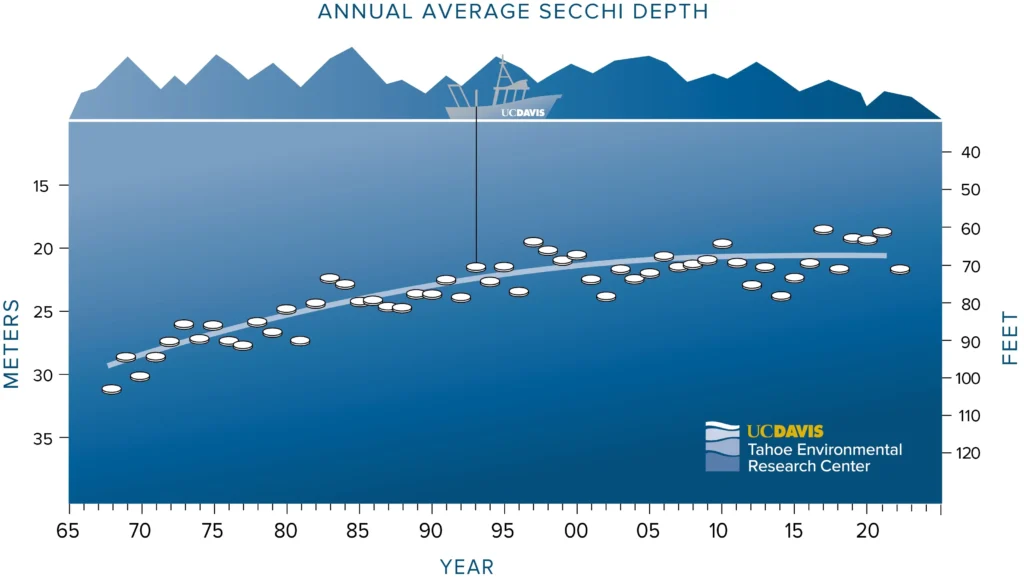
The UC Davis Tahoe Environmental Research Center and Tahoe Regional Planning Agency have released the annual Lake Tahoe Clarity Report, revealing that the average clarity of the lake dropped to 68.2 feet in 2023, down from 71.9 feet in 2022. Clarity is measured by how deep a 10-inch white disk can be lowered into the water before becoming invisible from the surface.
Despite this decline, the League to Save Lake Tahoe and other organizations have worked to halt the long-term clarity loss seen in the latter half of the 20th century. The establishment and implementation of the Lake Tahoe Total Maximum Daily Load (TMDL) have helped stabilize the lake’s clarity since 2000, with multi-year average clarity measurements showing relative stability.
“Two trends are highlighted in the report, which demand more study: winter water clarity is improving, while summer clarity is declining.” said Dr. Darcie Goodman Collins, CEO of the League to Save Lake Tahoe. “In the summer, the impacts of a warming climate create the right conditions for aquatic invasive species and algae to grow, and they drive more visitors to Tahoe escaping the heat at lower elevations.”
The report emphasizes several research priorities, including the impact of Tahoe’s changing physical and ecological conditions and the role of smaller particles, zooplankton, phytoplankton, and microplastics on the lake’s clarity.
To combat these issues, Dr. Collins emphasizes the importance of lake-friendly transportation decisions, such as using Lake Link and TART Connect to reduce car emissions and prevent road erosion and runoff. Additionally, investment in scientific research, litter prevention, and the restoration of Tahoe’s natural filtration systems, including marshes, meadows, and wetlands, are crucial.
“Clarity matters because the water is our biggest clue about how the Lake is doing,” Dr. Collins said. “If we lose the clear water of Tahoe, we lose everything we love about it. So, let’s all do our part to Keep Tahoe Blue.”
Lake Tahoe’s clarity is its most notable attribute. In the early 1900s, scientists gushed about being able to see 100 feet down into Big Blue, making it one of the most stunning lakes on the planet. In the century since, that clarity has gotten much worse, and despite scientists putting billions of dollars into its recovery, nothing is working.
Not only is Tahoe’s clarity a visual marvel, it also indicates the health of the lake. The marshes on each side of the lake act as a sort of filter for the water, creating a unique clarity. Many factors can contribute to its clarity, or lack thereof, but everyone seems to agree that it’s the central milestone to determining the health of the lake’s ecosystem.
In 2022, Lake Tahoe’s waters were exceptionally blue, with the highest clarity recorded since the 1980s. According to a report from the U.C. Davis Tahoe Environmental Research Center, scientists measured the lake’s clarity at 80.6 feet during the last five months of 2022.
